Boudoir Camera Settings

This post shows the technical side of how I like to capture your boudoir photos. The look of each image depends heavily on the boudoir camera settings I choose.

I shoot in full manual mode and use specific settings to create moody, yet tasteful boudoir images. If you’re wondering what’s happening behind the lens while you pose, here’s a breakdown of the exact settings I use and why.

Aperture

One of the first things I set is the aperture, and I usually shoot as wide open as possible—f/1.4, f/2.8, etc., depending on the lens.

A wide aperture gives you that soft, blurred background while keeping the focus sharp on the most important areas, like your eyes or lips. It also allows more light in, so I can keep your ISO low and your skin tones clean.

There are times when I’ll stop down for more depth of field, like if I want the background in focus for context. But in most boudoir sessions, shallow depth looks best.
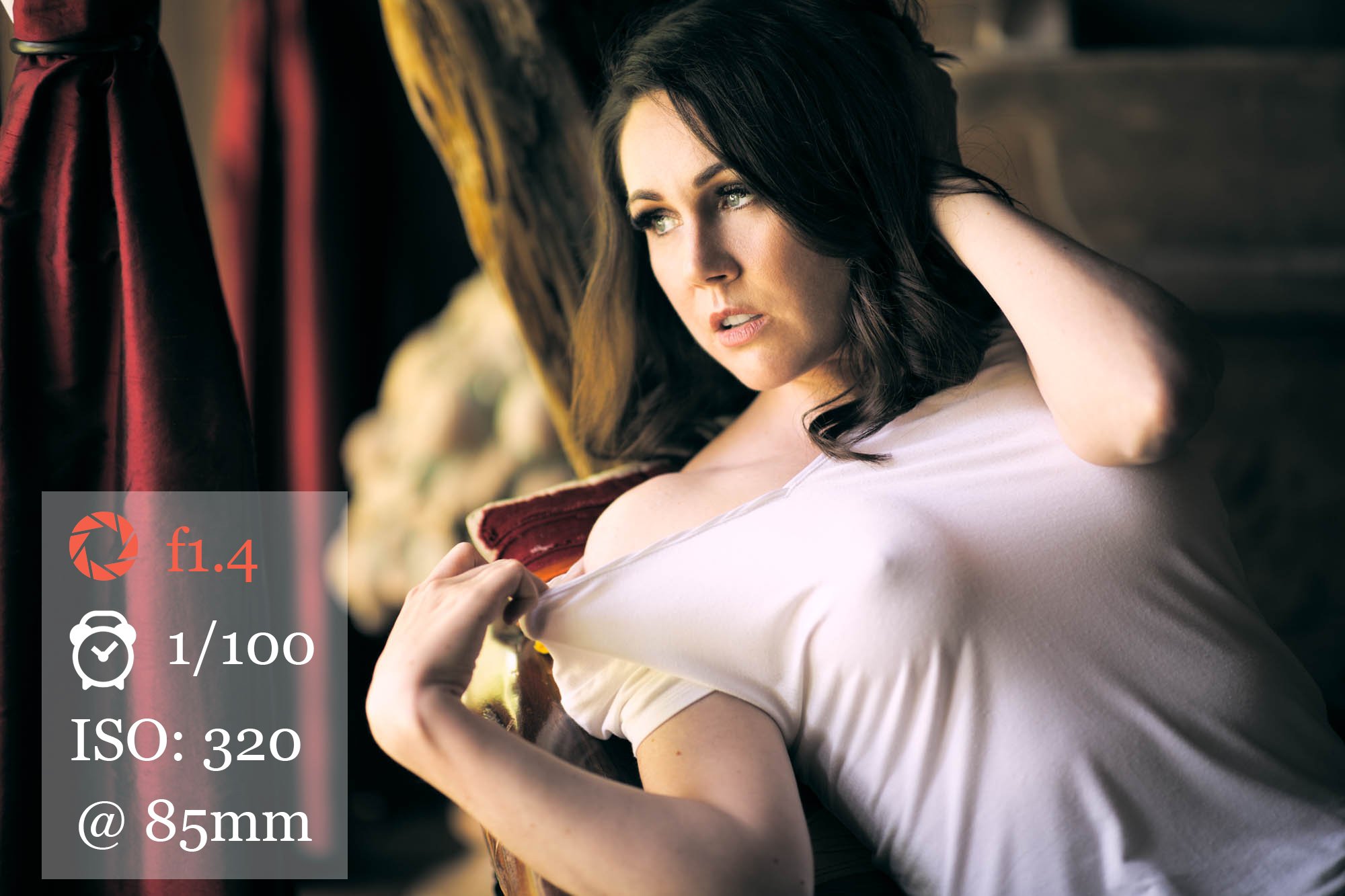
A woman poses indoors in soft, warm lighting, leaning back against a plush, vintage-style chair with one hand behind her head and the other tugging slightly at the neckline of her sheer white T-shirt, revealing the curve of her shoulder and collarbone. Her expression is sultry and thoughtful, with parted lips and intense eye contact directed slightly off-camera. The shallow depth of field creates a beautifully blurred background, enhancing the intimate atmosphere and drawing attention to the subject's face and form. Deep red drapes and rustic textures frame the scene, adding a moody, romantic tone. Prominently displayed in the lower left corner are camera settings, with aperture for boudoir photos highlighted as f/1.4, indicating the use of a wide aperture for a dreamy, softly focused effect. Additional technical details include a shutter speed of 1/100, ISO 320, and an 85mm focal length.

Shutter Speed

Once I’ve set the aperture, I balance exposure using ISO and shutter speed.

Most of my boudoir photos are shot between 1/125 and 1/160 of a second, especially if I’m using flash due to sync speed. This combination gives me sharp detail without motion blur, even if you shift slightly between poses.

That said, I shoot with the Canon R5, and some of my images, especially those using ambient light like candles or lamps, are captured as slow as 1/3 second.

In those cases, I’m intentionally dragging the shutter to preserve the warmth of the room without blowing out the skin tones. It’s a technique I use when I want the lighting to feel more intimate and natural.

On the other end of the spectrum, I’ll sometimes shoot with extremely fast shutter speeds—1/2000 and up, when photographing women in direct sunlight.

This combination gives a crisp, high-contrast look that works beautifully for bold, full-sun sessions.
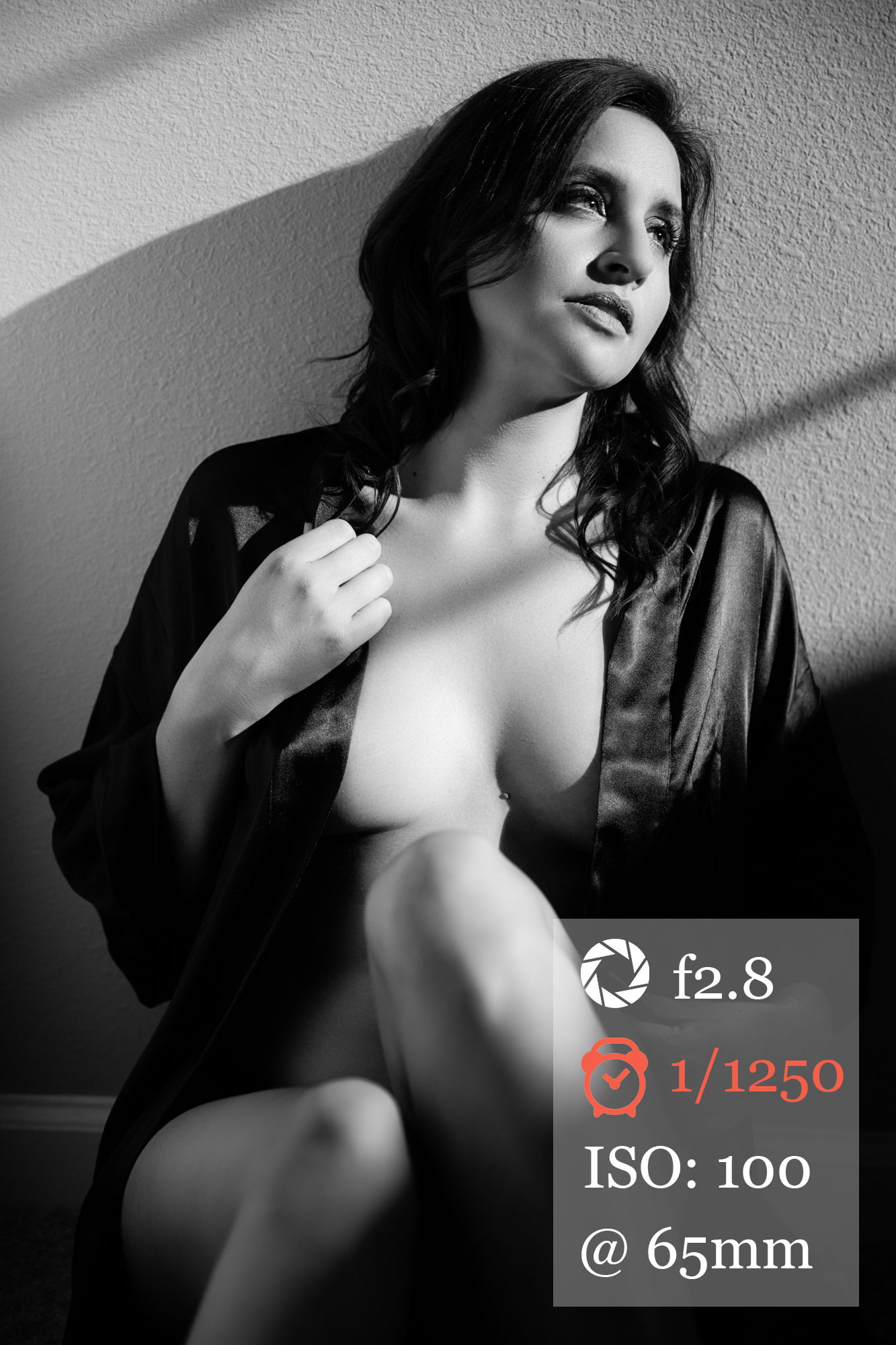
A woman is seated on the floor, leaning back against a textured wall, bathed in dramatic natural light that casts strong diagonal shadows across the scene. The black and white photograph emphasizes the interplay of light and shadow, highlighting the contours of her face and body with a striking, moody effect. She wears a silky black robe, parted to reveal her bare chest and a glimpse of a piercing, her expression calm and introspective as she gazes toward the light source. Her loosely curled dark hair frames her face, adding to the soft sensuality of the image. Prominently displayed in the lower right corner are the camera settings, with shutter speed for boudoir photos emphasized as 1/1250, indicating a very fast exposure to crisply capture the model and the contrast-heavy lighting. Additional settings include an aperture of f/2.8, ISO 100, and a 65mm focal length.

ISO

People obsess over ISO. They shouldn’t. Low ISO equals better quality, sure, but sometimes I want the ISO higher.

If I’m shooting with firelight or a single lamp, I’ll push ISO to 2000, 4000, even higher if needed.

My base ISO is 100, and I’ll stick to it when possible. But I won’t sacrifice exposure just to keep it artificially low.

It’s better to have a properly exposed high-ISO image than a noisy, underexposed low-ISO one.

A tattooed woman lies on her back across a wooden floor, her arms stretched out beside her head as she gazes upward with a relaxed and confident expression. Her platinum blonde hair contrasts with the warm tones of the scene, and she wears a sparkling, jewel-encrusted bra paired with white high-waisted lingerie bottoms and black lace garters. A fireplace glows in the background, casting a golden ambiance that softly illuminates her skin and the ornate textures of her outfit. The image exudes sensuality and strength, enhanced by the interplay of shadow and light. Prominently displayed in the upper left corner are the camera settings, with ISO for boudoir photos highlighted as ISO 800, indicating the use of higher sensitivity to effectively capture the low-light, moody atmosphere. Other technical details include an aperture of f/2.8, a shutter speed of 1/60, and a focal length of 88mm.

Most of your shoot will fall under ISO 100–2000 depending on the light. I raise it when I need to expose for:

  • Table lamps
  • Fireplaces
  • Candles
  • Window light on overcast days

Fast prime lenses (f/1.4 or faster) help a lot here. They let me work with low light and keep the ISO cleaner than a kit zoom could.


Autofocus Settings

Focus mode depends on the shot. On DSLRs, I used single-point autofocus and recompose. On my mirrorless Canon R5, I bounce between Eye AF and single-point depending on where I want focus.

Eye AF is great when your eyes are open and facing the camera. If you’re glancing down, blinking, or turned just enough, Eye AF can miss, so I fall back on spot AF when needed.

My Eye AF Settings (Canon R5):

These are the settings I use if the camera has a good front on view of my subject’s eyes.

  • Eye Detection: Enabled
  • Continuous AF: Disabled
  • Back-button focus
  • AF Operation: Servo
  • AF Method: Eye AF
  • Subject to Detect: People
A woman in burgundy lace lingerie poses sensually in front of a mirror, one arm raised above her head while the other hand rests near her chin, drawing attention to her facial expression. Her gaze is softly focused as she looks at her reflection, with dim, moody lighting casting gentle shadows that enhance the intimate ambiance of the boudoir setting. The focus is precisely locked onto her eye, indicated by a red square around it and a highlighted path leading to an overlay of the Canon R5 autofocus settings screen. The inset display in the bottom right shows the AF method menu, with the Eye AF Settings for boudoir photos with Canon R5 clearly emphasized. Only "Spot AF" and "Eye AF" are marked with green checkmarks, while all other AF modes are crossed out with red Xs, reinforcing that these two focus methods are the preferred and most accurate for capturing sharp, emotive portraits in boudoir photography. A translucent caption box along the bottom center reiterates this recommendation with the text "Spot AF & Eye AF Only" in elegant typography.

Other Camera Settings For Boudoir Photography

These settings don’t really affect the look of your photos so much, but if you’ve made it this far you probably would like to know the camera settings for boudoir photography that I use. So the following is what I consider to be the best camera settings for boudoir photos.

Exposure Simulation

When I’m working with natural light, I keep exposure simulation turned on so I can see the scene exactly as it’ll be captured—right through the viewfinder. It helps me dial in the lighting before I ever take a test shot. If I’m lighting the entire scene with off-camera flash, I turn it off. Otherwise, the viewfinder goes completely dark, which isn’t helpful when I need to frame your pose precisely.

Highlight Alert

This setting shows me if I’ve blown out any part of the image—like a window or a highlight on your skin. I leave it on at all times. Sometimes I’ll intentionally let a background light overexpose, but I want to know exactly where that’s happening. Highlight alert gives me that feedback instantly, so I’m not guessing.
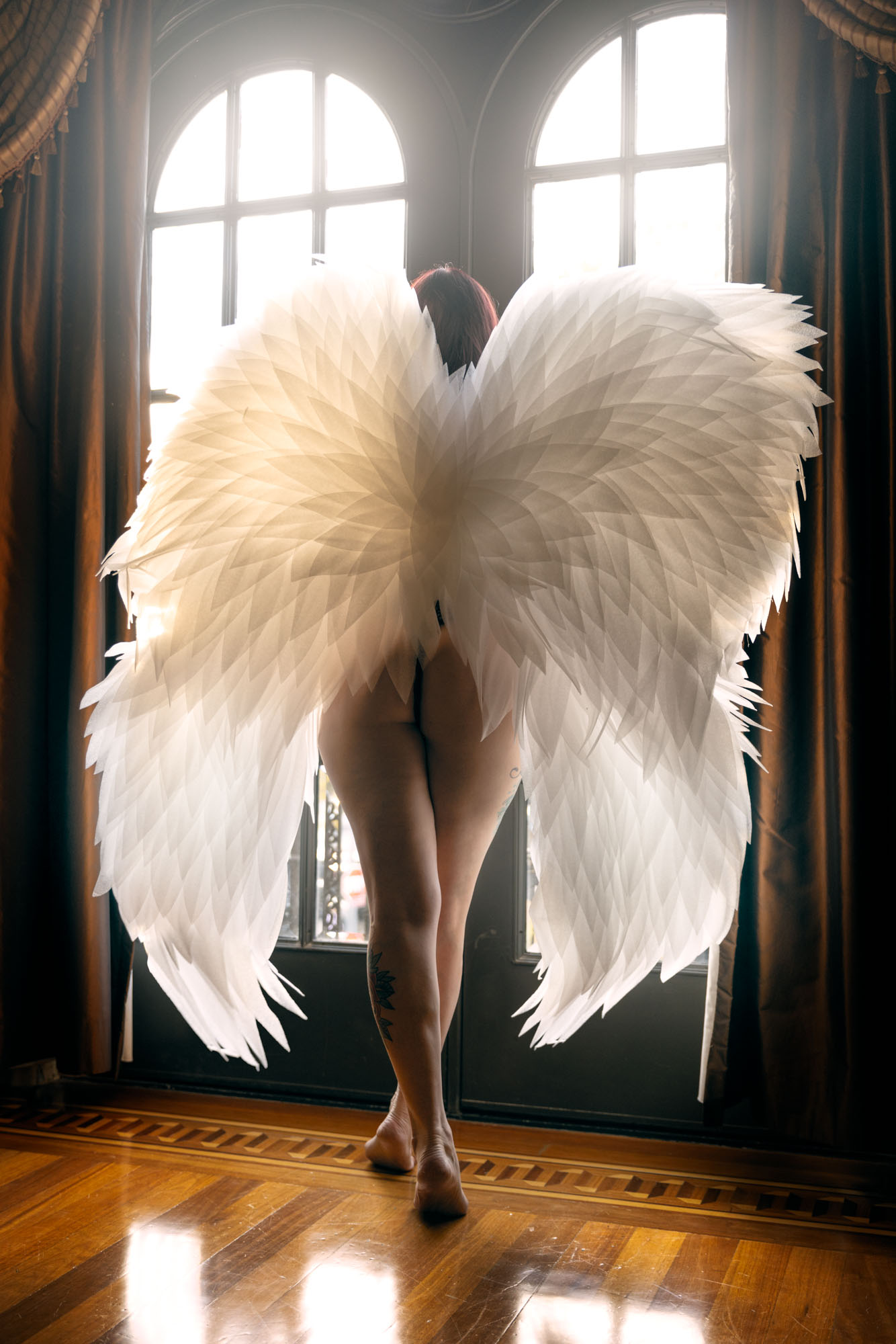
A woman with red hair poses with large white angel wings spread wide to illustrate the best camera settings for boudoir photography. The woman is barefoot and backlit by arched French doors with golden curtains framing the windows and a polished wooden floor beneath her feet.

RAW Format + Dual Card Backup

Every image is captured in the largest RAW format possible, which preserves the full detail, color depth, and dynamic range of your photos. It also gives me full control in post, in case I need to fine-tune anything. I record to two cards simultaneously, one primary and one backup. If a card ever fails, the photos are still safe on the backup.


Why Boudoir Camera Settings Matter

Settings matter because quality matters. While it’s true that modern digital files are quite information dense, nailing the exposure in camera always leads to the best quality.

Without knowing how to manually set your aperture, shutter speed and iso it will be very difficult to make a good boudoir photo.

Without the right settings, even the best posing means very little. For instance, if the exposure is 3 stops over exposed and washing out her skin tone, none of the other great stuff you did matters.

So, while posing and lighting are crucial, the technical aspects, like aperture, shutter speed, and ISO, are really the fundamentals of a good exposure.

Additionally semi automatic modes like AV (aperture value) or TV (time value) leave too many stylistic decisions to a computer that I’d rather be in control of. It is for these reasons (among others) that I always capture boudoir photos in manual mode.
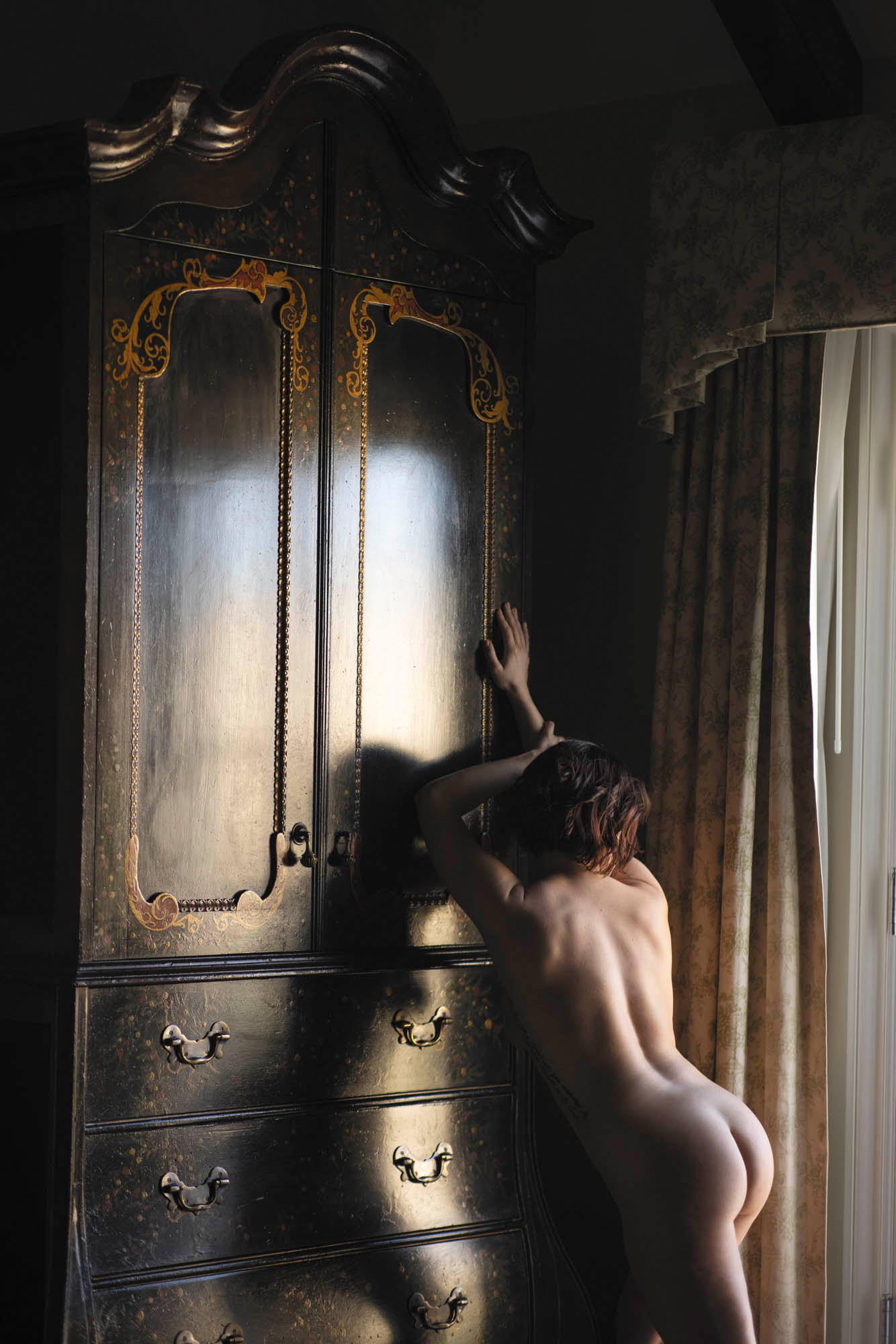
A woman poses in a softly lit boudoir scene, standing topless with her back to the camera as she leans slightly forward against a dark wooden dresser near a tall French door. She wears only a pair of black lace panties that accentuate her figure, with her short dark hair slightly tousled. The natural light streaming in from the window casts a gentle glow on her skin, creating soft shadows that highlight the contours of her back and legs. Outside the glass-paned doors, a wrought iron balcony railing is visible, with the blurred shapes of tall trees in the distance. The room’s ambiance is elegant and intimate, featuring heavy, patterned drapes in a muted golden tone. The image's composition and focus suggest attention to boudoir camera settings, with a shallow depth of field blurring the background and bringing emphasis to the subject in the foreground. The lighting appears natural and directional, possibly captured during golden hour, enhancing the mood and warmth of the scene.

Boudoir Camera Settings FAQ

Below are some common questions I sometimes get about boudoir camera settings

  1. What Settings Should I Use For Boudoir Photography?

    Shoot in manual mode for the most control. Use the widest aperture your lens allows (like f/1.4 or f/2.8) to create soft, dreamy backgrounds. Keep your shutter speed between 1/125–1/160 to avoid blur. ISO should stay low (100–2000), but don’t be afraid to raise it in low light or to match warm elements like lamps or candles. Use Eye AF or Spot AF to keep focus on your eyes or other details. And always shoot in RAW. Your photos will look way better with edits.

  2. What is the Best Aperture for Boudoir Photography?

    Most of the time, the best aperture is as wide as your lens will go (f/1.2–f/4). This creates that shallow depth of field look and helps your client stand out from the background. Wide apertures are also good for low light conditions indoors. If you want more background in focus or you’re shooting in full sun, f/8–f/11 is a great starting point and is typically the sharpest part of the lens.

Scroll to Top